While I was out cruising the web I stopped by Amanda Jean's blog crazy mom quilts a while back and she was showing a quilt she had complete with a free-hand quilting pattern I thought would look good on my jelly roll/lasagna quilt. I don't free-hand quilt because, honestly, I don't want to put the practice in to be good at it. So what to do?
Remember making your own stencils before you could buy Mylar quilting stencils? Being the antique that I am (Actually I'm still only a collectible because I'm still less than a hundred.) and inheriting a few from my mother, I did just that. Time to get the old trusty paper and pencil out, again.
My first step was to draw a strip two inches wide (that's the width of my fabric strips). Find center, and then draw two lines the width you think you want the quilting to be. The first try I decided I would make the quilting one-inch wide. Using the cap off my vitamin bottle to make my curved line I drew a sample. I thought the first try was too wide, so on the next try I cut the width of my curved line down to a half-inch. I liked it much better.
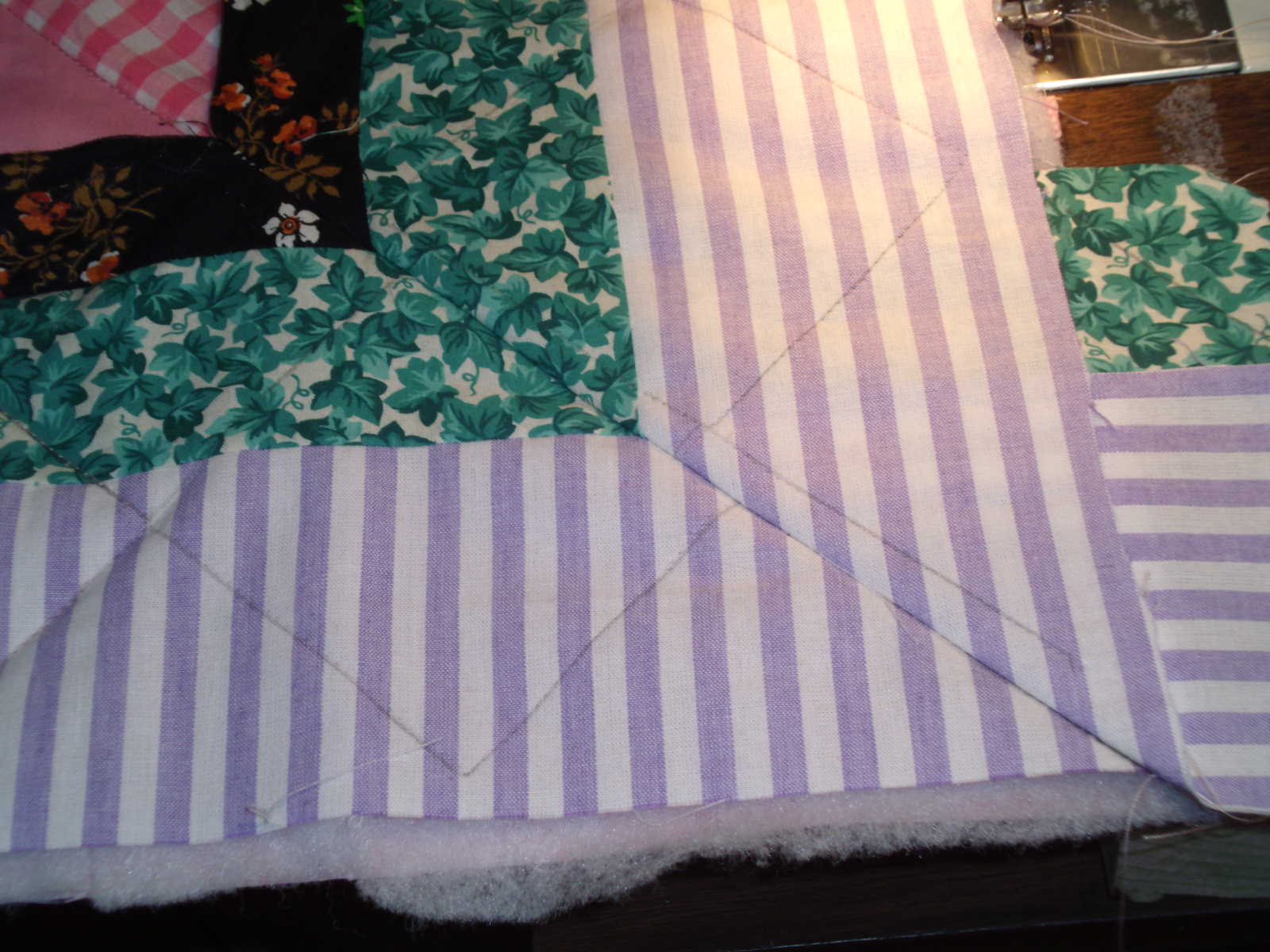
Next, I opened up a cereal box and drew the pattern on to it, then cutting the design out. I used my graphite and white quilting pencils to draw the pattern on four of the nine patches of the quilt. As you can see I drew the curved lines down the centers of the strips both front and back of the selected blocks.
Kind a looks like jigsaw puzzle pieces to me! I think it helped the over-all look of the quilt having some blocks quilted this way and some with stitch-in-the-ditch.
For the borders I decided a large diamond would be just the ticket for finishing off the quilting. Also notice, I used white thread for the large blocks and black thread for the border. Don't be afraid of using different color threads for the quilting it can make a dull quilt come to life.
I think I am going to continue channeling my mother today and stay in my nightgown all day. Maybe do some baking (cookies and bread) and a pot of soup sounds good, too.
I hope everyone is having a good day!
Judy
To keep track what I have been up to and my thoughts on issues important to me.
Showing posts with label quilt tutorial. Show all posts
Sunday, October 5, 2014
Friday, September 2, 2011
designing a quilt - the binding
There are several different ways to make binding. One is to make the backing larger and roll the edge over and top stitch down. It works, looks nice, and I have used it on lots of comforts. However it also wears out faster because it is a single layer of fabric. I have used the satin blanket binding you can buy, once again; it works, looks nice but doesn't wear to well. The one I use the most frequently is the bias French binding. My fabric is cut on the bias and doubled over. The raw edges are sewn together on the quilt and the fold line is brought around and either slipped stitched to enclose the raw edges or is top-stitched down. Heirloom quality quilts the binding is hand-finished. Quilts I want used are top-stitched down.
Find the perimeter of your quilt in this case is 63+63+88.5+88.5=303". Multiply the length times the width of the binding unfolded. I wanted my binding 2.5" wide, so 303x2.5=757.5 square inches of fabric for the binding. Divide the square inches by the width of your fabric. I always use 40 inches to give you the length of fabric you will need. 757.5/40=18.93 or a little more than a half yard. This also helps when making binding from scraps and knowing if you have enough scrapes to piece together to make your binding. So I used the rotary-cutter and cut me up a bunch of strips.
I always use seam allowances that are at a 45 degree angle because they reduce bulk when folded in half and the seams are on grain (no stretched seams). I also always start by laying them out end to end to get my seams allowance right. Otherwise you end with some 90-degree angles. Who wants to rip? Not me!
I pin my seam allowances. Notice the edges are off set the width of the seam allowance so that when you open up the seam allowances the top and bottom edges are straight.
I use a 1/4" seam allowance and gang piece my seams.
Press seam allowances to one side then fold in half and press a crease down the middle. Measure to see if you have enough binding. It is easier to add to length of binding when the binding is not sewn to the quilt!
Because I was going to apply the binding from the back instead of the front I trimmed the excess backing and batting off the quilt. If I am applying the binding from the front I don't trim.
I pin my binding on, a lot of people don't. I don't want my binding to stretch because it is on the bias. I also don't want the raw edges shifting and I not catch them all in the seam allowance and have to go back and rip. (Shudder! Did I mention I really, really don't like to rip?) The photos of how to make mitered corners with your binding didn't turn out so here are some links so you can see the process. This is part One and Two and Three. One additional step I make is to over-stuff the binding. I've been told by quilters I respect that over-stuffing the binding cuts the wear of the binding. I also like the looks of an over-stuffed binding. What I do is cut 1/4 to 1/2-inch pieces of batting and place up against the raw edges. You do have to pin your binding closed: however to make it easier to top-stitch it closed. So what does this quilt look like finished?
TA! DA!
Detail photo of the corner!
And somebody taking a rest on the quilt!
There are no wrong ways to make a quilt. Do whatever suits your fancy. Remember the function of a quilt is to keep someone warm. So have fun and make quilts!
Have a good day!
Judy
Find the perimeter of your quilt in this case is 63+63+88.5+88.5=303". Multiply the length times the width of the binding unfolded. I wanted my binding 2.5" wide, so 303x2.5=757.5 square inches of fabric for the binding. Divide the square inches by the width of your fabric. I always use 40 inches to give you the length of fabric you will need. 757.5/40=18.93 or a little more than a half yard. This also helps when making binding from scraps and knowing if you have enough scrapes to piece together to make your binding. So I used the rotary-cutter and cut me up a bunch of strips.
I always use seam allowances that are at a 45 degree angle because they reduce bulk when folded in half and the seams are on grain (no stretched seams). I also always start by laying them out end to end to get my seams allowance right. Otherwise you end with some 90-degree angles. Who wants to rip? Not me!
I pin my seam allowances. Notice the edges are off set the width of the seam allowance so that when you open up the seam allowances the top and bottom edges are straight.
I use a 1/4" seam allowance and gang piece my seams.
Press seam allowances to one side then fold in half and press a crease down the middle. Measure to see if you have enough binding. It is easier to add to length of binding when the binding is not sewn to the quilt!
Because I was going to apply the binding from the back instead of the front I trimmed the excess backing and batting off the quilt. If I am applying the binding from the front I don't trim.
I pin my binding on, a lot of people don't. I don't want my binding to stretch because it is on the bias. I also don't want the raw edges shifting and I not catch them all in the seam allowance and have to go back and rip. (Shudder! Did I mention I really, really don't like to rip?) The photos of how to make mitered corners with your binding didn't turn out so here are some links so you can see the process. This is part One and Two and Three. One additional step I make is to over-stuff the binding. I've been told by quilters I respect that over-stuffing the binding cuts the wear of the binding. I also like the looks of an over-stuffed binding. What I do is cut 1/4 to 1/2-inch pieces of batting and place up against the raw edges. You do have to pin your binding closed: however to make it easier to top-stitch it closed. So what does this quilt look like finished?
TA! DA!
Detail photo of the corner!
And somebody taking a rest on the quilt!
There are no wrong ways to make a quilt. Do whatever suits your fancy. Remember the function of a quilt is to keep someone warm. So have fun and make quilts!
Have a good day!
Judy
Monday, August 29, 2011
Design a quilt - adding the border
Time to get this quilt finished!
I figured the over all length and width of the quilt as I wanted mitered corners and was able to cut the two outside borders in one strip for each side. How does that work? The center of the quilt measured 51" x 76.5". I wanted to add 3 borders with a total width of 6" which would bring the outside dimensions to 63" x 88.5". With that information I need two pieces of each of the three borders at least 63" long and two pieces of each of the three borders 88.5" long. Experience has taught to make the borders a couple of inches longer. It is easier to cut off than have to add on! The inside border had to be pieced. You can piece borders one of two ways with seams on grain or biased seams. Biased seams are less noticeable particularly when hand-quilting.
I have found a graphite type quilting pencil I really like for marking quilts. The lead is easy to sharpen in a pencil sharpener and makes a nice line. One caveat: Do Not Drop It. The lead breaks into a bunch of little pieces, in the pencil, and are useless except as a placeholder to keep the lead from pushing back into the pencil. (Since developing tendonitis in the right arm I grip too firmly and press down with the whole arm.)
I wanted a simple quilting design that mirrored the quilt design for the center. While digging through Mother's template stash I found a block cutting template that was perfect. I have learned to find center and start my marking from there after years of being dissatisfied with the results when starting at one end and going to the other.
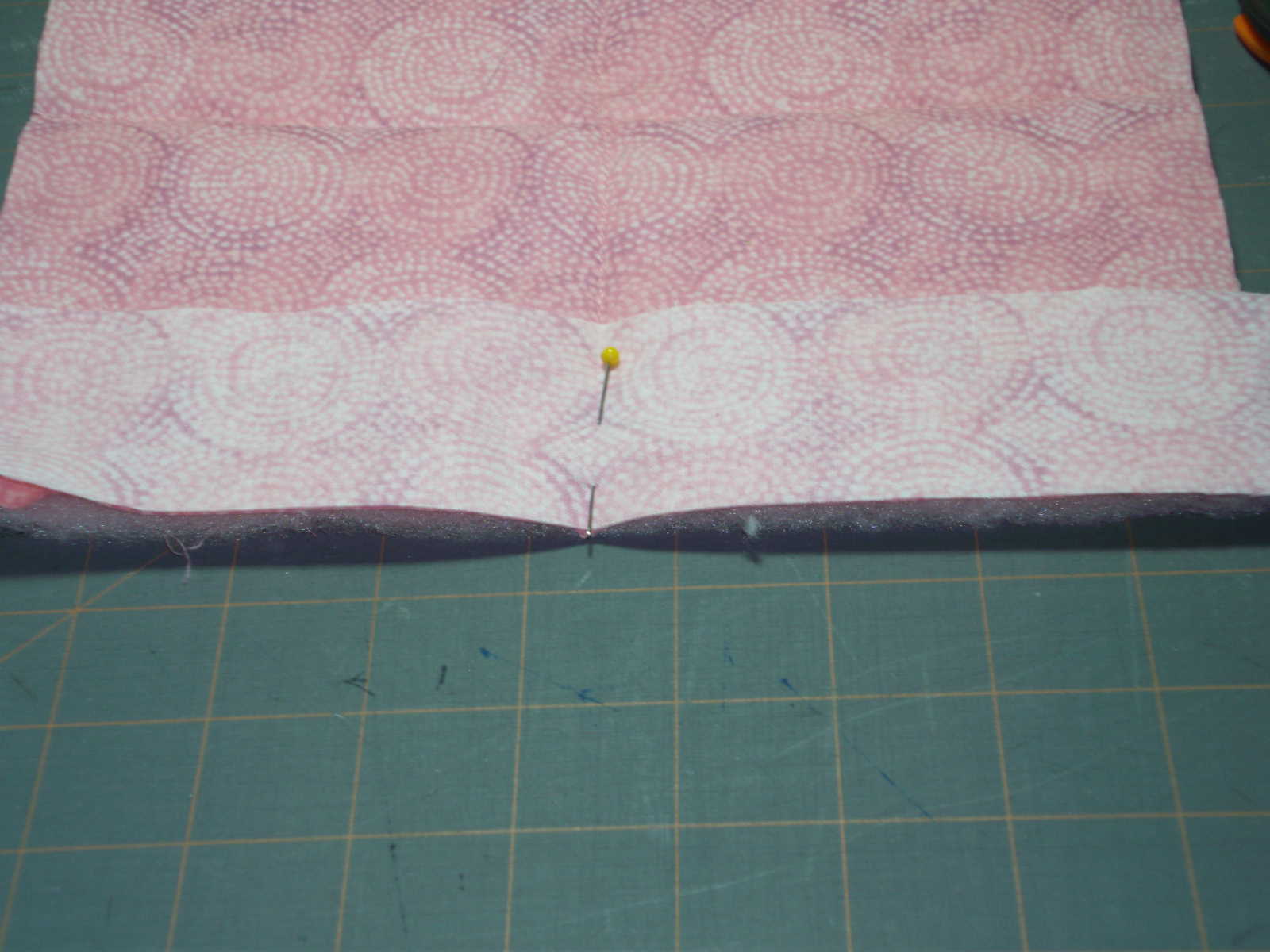
I then pinned the three layers together at the points.
And quilt away!
I then pinned the inner most borders on and sewed them on with 1/4- inch seam allowance. As you can see the backing is about one inch longer than the border.
I used a 1/2- inch seam allowance to attach the backing to the quilt center. Here is where I find out that what I wanted to do didn't work!! I had to do some picking out of quilting! AARRGGHH!
As you can see I had to trim the excess off of the long sides of the quilt. Then take the short sides and sew the backing all the way across instead of ending at the edge of the center of the quilt and miter the corners. And I had to do more picking out of the quilting! RATS!!
I pinned back the borders and trimmed up the batting to fit.
Then I laid the borders so they over lapped and squared of the strips so they would match.
Got my ruler out and marked where the 45-degree seam would go.
Turned the seams to the wrong side and sewed on the line
Turned it right side out and checked to make sure it laid flat.
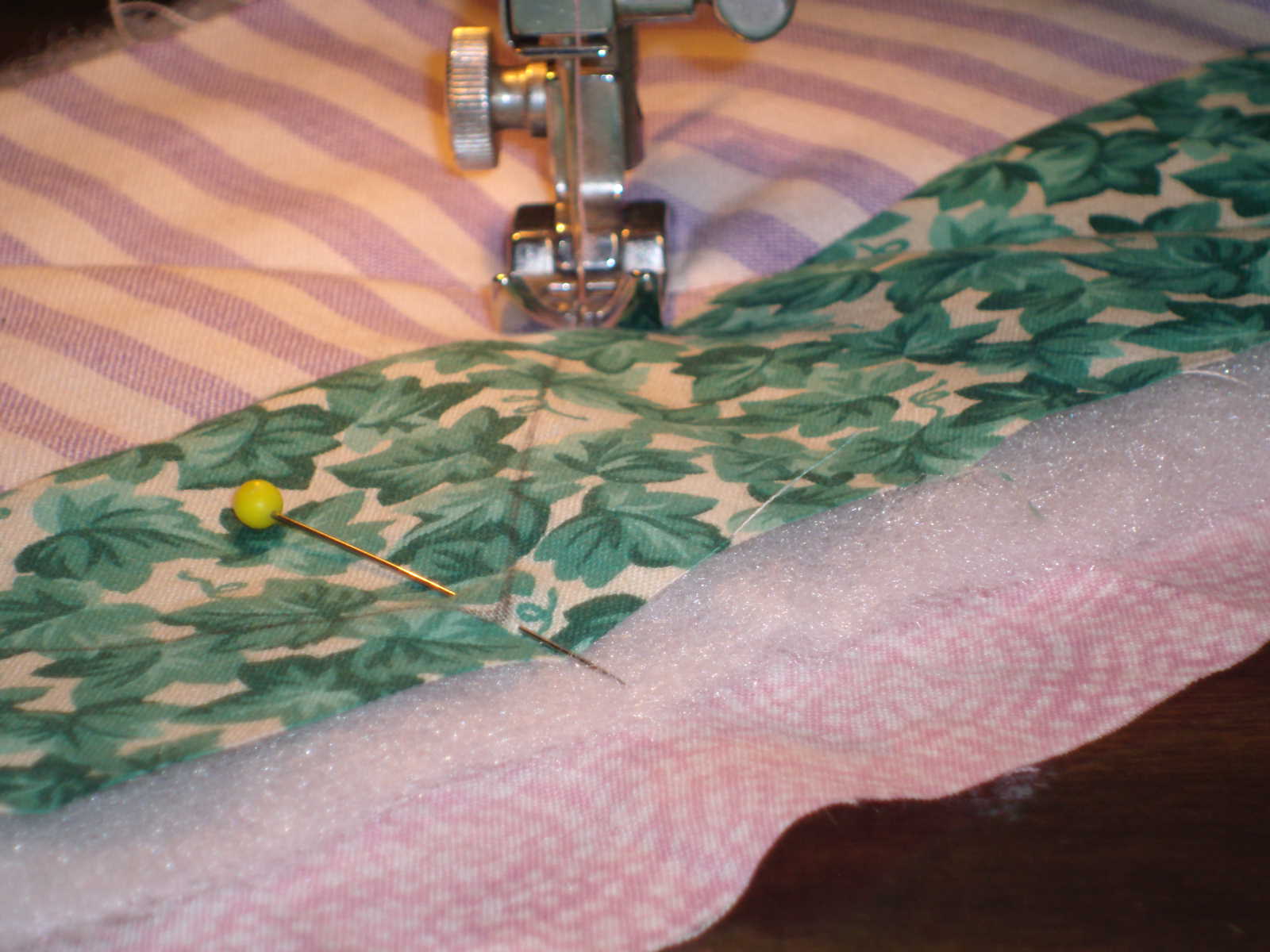
I trimmed the excess off leaving a 1/4-inch seam allowance. Pinned everything in place and adjusted quilt lines so they flowed into each other around the corner.
Re-quilted everything I had picked out.
Then I turned a 1/4-inch of the edge of the inside border under, pinned, and topstitched the edge down.
All and all the idea of quilting your borders and then attaching would work best IF you are not trying to miter the corners. Horizontal borders with or without cornerstones would be the best way to use this idea at this point. If you want mitered corners you will most likely want to attach the borders and backing and then add the batting and quilt.
This post is long enough so I will show you how I make binding and the photos of the finished quilt in another post.
Have a great day!
Judy
I figured the over all length and width of the quilt as I wanted mitered corners and was able to cut the two outside borders in one strip for each side. How does that work? The center of the quilt measured 51" x 76.5". I wanted to add 3 borders with a total width of 6" which would bring the outside dimensions to 63" x 88.5". With that information I need two pieces of each of the three borders at least 63" long and two pieces of each of the three borders 88.5" long. Experience has taught to make the borders a couple of inches longer. It is easier to cut off than have to add on! The inside border had to be pieced. You can piece borders one of two ways with seams on grain or biased seams. Biased seams are less noticeable particularly when hand-quilting.
I have found a graphite type quilting pencil I really like for marking quilts. The lead is easy to sharpen in a pencil sharpener and makes a nice line. One caveat: Do Not Drop It. The lead breaks into a bunch of little pieces, in the pencil, and are useless except as a placeholder to keep the lead from pushing back into the pencil. (Since developing tendonitis in the right arm I grip too firmly and press down with the whole arm.)
I wanted a simple quilting design that mirrored the quilt design for the center. While digging through Mother's template stash I found a block cutting template that was perfect. I have learned to find center and start my marking from there after years of being dissatisfied with the results when starting at one end and going to the other.
I then pinned the three layers together at the points.
And quilt away!
I then pinned the inner most borders on and sewed them on with 1/4- inch seam allowance. As you can see the backing is about one inch longer than the border.
I used a 1/2- inch seam allowance to attach the backing to the quilt center. Here is where I find out that what I wanted to do didn't work!! I had to do some picking out of quilting! AARRGGHH!
As you can see I had to trim the excess off of the long sides of the quilt. Then take the short sides and sew the backing all the way across instead of ending at the edge of the center of the quilt and miter the corners. And I had to do more picking out of the quilting! RATS!!
I pinned back the borders and trimmed up the batting to fit.
Then I laid the borders so they over lapped and squared of the strips so they would match.
Got my ruler out and marked where the 45-degree seam would go.
Turned the seams to the wrong side and sewed on the line
Turned it right side out and checked to make sure it laid flat.
I trimmed the excess off leaving a 1/4-inch seam allowance. Pinned everything in place and adjusted quilt lines so they flowed into each other around the corner.
Re-quilted everything I had picked out.
Then I turned a 1/4-inch of the edge of the inside border under, pinned, and topstitched the edge down.
All and all the idea of quilting your borders and then attaching would work best IF you are not trying to miter the corners. Horizontal borders with or without cornerstones would be the best way to use this idea at this point. If you want mitered corners you will most likely want to attach the borders and backing and then add the batting and quilt.
This post is long enough so I will show you how I make binding and the photos of the finished quilt in another post.
Have a great day!
Judy
Sunday, July 24, 2011
Designing a quilt - putting it together
In the last post we had the blocks put together based on our quilt design here. So now I am going to "quilt as you go". I found several videos on you-tube. Here are some links:
http://www.youtube.com/watch?v=kArIng_1Nzc
http://www.youtube.com/watch?v=-pL36s08wg4&feature=related
http://www.youtube.com/watch?v=gYkIh_fsyiE&feature=related
This one is not a video: http://welshquilter.blogspot.com/2008/02/quilt-as-you-go.html
I cut my backing and batting 1/2-inch larger than I want my block, because I dislike wasting fabric or batting. (In this case I cut the backing and batting in 9 1/2-inches square for the blocks and cut an eleven-inch square in half for the right triangles.) Pin the quilt sandwich together and quilt in a design that pleases you. I did stitch-in-the-ditch, leaving the pins in the corners.

I laid my quilted block out ready to trim it up.

I took a 10" square ruler and set it 1/4-inch from the edge of the quilt block and cut the excess off with my rotary cutter.

I am cutting my quilted blocks this way because I want to add 1-inch sashing strip with cornerstone around each block. I will be sewing 1/2-inch from the edge which will catch 1/4-inch seam allowance around each block and give me the batting I need for the sashings without adding extra batting.

Let me show you how this works! I cut a 2 by 9 1/4-inch strip of backing material and pinned it to the backing right-sides together.
Note: I tried a one-inch wide strip but because the blocks I am using don't extend to the edge, it was a pain to come back and add the sashing strips on the block side. I also discovered while using scraps from cutting the 9 1/2-inch squares of backing that I liked the bit of excess on the back-sashing strips.

Turn the quilted block over and pin the top-sashing strip on the edge of the block. I used 1 1/2 by 9 1/4 strip.

Put the block in the machine and sew 1/2-inch from the edge. Notice I am catching a 1/4-inch seam allowance on the quilt block and top-sashing with 1/2-inch of batting, backing, and bottom-sashing.

Then you pin the bottom-sashing to the next quilted block lining up edges.
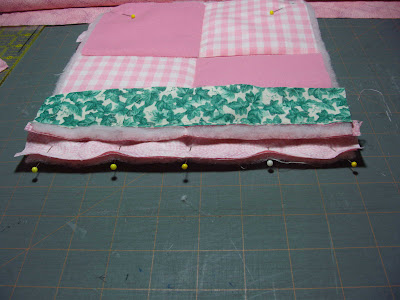
This is a view from the side you will be sewing from. Notice all the pins? This is to hold everything so nothing slides around.

Before putting the pinned together blocks in the machine make sure the top-sashing is lying flat and not folded over where you are going to sew the seam. It is a pain to rip out! Sew another 1/2-inch seam.

This is a row of blocks sewn together.

Fold the top-sashing over your seams with a 1/4-inch tuck and pin.

Top stitch close to the edge and trim off the excess off each end of the sashings.

Next cut 1 1/2-inch squares for the cornerstones and 1 1/2 by 8 1/2-inch top-sashing strips. Gang piece all the units together until you have long strips for each row. For the end triangle cornerstones I found it easier to just sew 1 1/2-inch squares on the ends of my strips and trim off the excess material. It ended the frustration of not getting the triangles pointed in the right direction and having to rip. Can you tell I don't like to rip! LOL! Piece long 2-inch strips for the back-sashing.

Do the same pinning routine you did to get the row of blocks set together. The back-sashing is pinned to the edge of the backing and the top-sashing is pinned on the edge of the quilt block. Be sure and center your cornerstones over the top-sashing that are separating the quilt blocks. Sew 1/2-inch from the edge catching 1/4-inch of the top-sashing and quilt block.

Then pin the back-sashing to the previous row, be sure you line up your sashings that tied the rows of blocks together so when you get to the top stitching of the top-sashing the cornerstones line up where they belong. Sewing 1/2 inch seam allowance.
I

Fold over the top-sashing with a 1/4-inch tuck, pin, and top stitch down. Trim off any excess at the ends.

A detail shot of the row just finished.

Repeat until you have the center of the quilt done. (Notice my grass is going dormant because of the heat and lack of rain.)

All-n-all this gave me the traditional look I wanted on this quilt without having to wrangle large quantities of fabric in my machine. I think if I wanted wider top-sashings I would make the backing and batting the size I would need and use a 1-inch back-sashing then use the correct width top-sashing. For instance, had I wanted 2-inch sashing on top, instead of a 9-inch quilted block I would have made a 10-inch quilted block. I would use a 1-inch wide piece of sashing on bottom (or backing) with 1/4 inch seam allowances which would catch a 1/4 inch of the batting and keep it from bunching. Then a 2 1/2-inch sashing on top with 1/4-inch seam allowances to catch the edge of the quilt block. I would have to play with the concept to see if it worked and where the theory would have to be refined.
Well on to the borders! I have some ideas I think will work for quilting the borders and then attaching them, instead of the other way around. That will be the next post on this quilt.
Until then have a good day!
Judy
http://www.youtube.com/watch?v=kArIng_1Nzc
http://www.youtube.com/watch?v=-pL36s08wg4&feature=related
http://www.youtube.com/watch?v=gYkIh_fsyiE&feature=related
This one is not a video: http://welshquilter.blogspot.com/2008/02/quilt-as-you-go.html
I cut my backing and batting 1/2-inch larger than I want my block, because I dislike wasting fabric or batting. (In this case I cut the backing and batting in 9 1/2-inches square for the blocks and cut an eleven-inch square in half for the right triangles.) Pin the quilt sandwich together and quilt in a design that pleases you. I did stitch-in-the-ditch, leaving the pins in the corners.

I laid my quilted block out ready to trim it up.

I took a 10" square ruler and set it 1/4-inch from the edge of the quilt block and cut the excess off with my rotary cutter.

I am cutting my quilted blocks this way because I want to add 1-inch sashing strip with cornerstone around each block. I will be sewing 1/2-inch from the edge which will catch 1/4-inch seam allowance around each block and give me the batting I need for the sashings without adding extra batting.

Let me show you how this works! I cut a 2 by 9 1/4-inch strip of backing material and pinned it to the backing right-sides together.
Note: I tried a one-inch wide strip but because the blocks I am using don't extend to the edge, it was a pain to come back and add the sashing strips on the block side. I also discovered while using scraps from cutting the 9 1/2-inch squares of backing that I liked the bit of excess on the back-sashing strips.

Turn the quilted block over and pin the top-sashing strip on the edge of the block. I used 1 1/2 by 9 1/4 strip.

Put the block in the machine and sew 1/2-inch from the edge. Notice I am catching a 1/4-inch seam allowance on the quilt block and top-sashing with 1/2-inch of batting, backing, and bottom-sashing.

Then you pin the bottom-sashing to the next quilted block lining up edges.

This is a view from the side you will be sewing from. Notice all the pins? This is to hold everything so nothing slides around.

Before putting the pinned together blocks in the machine make sure the top-sashing is lying flat and not folded over where you are going to sew the seam. It is a pain to rip out! Sew another 1/2-inch seam.

This is a row of blocks sewn together.

Fold the top-sashing over your seams with a 1/4-inch tuck and pin.

Top stitch close to the edge and trim off the excess off each end of the sashings.

Next cut 1 1/2-inch squares for the cornerstones and 1 1/2 by 8 1/2-inch top-sashing strips. Gang piece all the units together until you have long strips for each row. For the end triangle cornerstones I found it easier to just sew 1 1/2-inch squares on the ends of my strips and trim off the excess material. It ended the frustration of not getting the triangles pointed in the right direction and having to rip. Can you tell I don't like to rip! LOL! Piece long 2-inch strips for the back-sashing.

Do the same pinning routine you did to get the row of blocks set together. The back-sashing is pinned to the edge of the backing and the top-sashing is pinned on the edge of the quilt block. Be sure and center your cornerstones over the top-sashing that are separating the quilt blocks. Sew 1/2-inch from the edge catching 1/4-inch of the top-sashing and quilt block.

Then pin the back-sashing to the previous row, be sure you line up your sashings that tied the rows of blocks together so when you get to the top stitching of the top-sashing the cornerstones line up where they belong. Sewing 1/2 inch seam allowance.
I

Fold over the top-sashing with a 1/4-inch tuck, pin, and top stitch down. Trim off any excess at the ends.

A detail shot of the row just finished.

Repeat until you have the center of the quilt done. (Notice my grass is going dormant because of the heat and lack of rain.)

All-n-all this gave me the traditional look I wanted on this quilt without having to wrangle large quantities of fabric in my machine. I think if I wanted wider top-sashings I would make the backing and batting the size I would need and use a 1-inch back-sashing then use the correct width top-sashing. For instance, had I wanted 2-inch sashing on top, instead of a 9-inch quilted block I would have made a 10-inch quilted block. I would use a 1-inch wide piece of sashing on bottom (or backing) with 1/4 inch seam allowances which would catch a 1/4 inch of the batting and keep it from bunching. Then a 2 1/2-inch sashing on top with 1/4-inch seam allowances to catch the edge of the quilt block. I would have to play with the concept to see if it worked and where the theory would have to be refined.
Well on to the borders! I have some ideas I think will work for quilting the borders and then attaching them, instead of the other way around. That will be the next post on this quilt.
Until then have a good day!
Judy
Tuesday, May 10, 2011
Designing a quilt - color

Image from http://www.rewaj.com/fashion/understand-colors-with-color-wheel.html
Upon reviewing what I have written about designing a quilt the one area I have not covered well, in my mind, is color. In fact, I have kind of glossed it over. After some reflection I believe the reason is I just don't know that much about the subject. This color wheel sums up what I know. The three primary colors, secondary and tertiary colors, they go from light to dark. That's about it. The whys and hows of using one color over another I don't really understand. I've taking a color class and I continue to read about color but I really don't understand it. Why do I pick one color over another? Beats me.
All I can tell you about the way that I decide which fabric to put with another is by trial and error. Place a fabric beside another and saying, yes, that looks good or, yuck, I think not. I know I make good color choices because people I respect in the quilting world like my quilts.
So my advice to you is go with what looks good to you. Really, whatever looks good to you! You will like some of your choices better than others. We all have quilts that we look at shake our heads and say, "What was I thinking?" I have one that I use backing up because I really don't like the way the top went together. The quilt does the job it is suppose to do, keep me warm, but I still think it is ugly. So go have some fun and make a quilt you like!
Have a good day!
Judy
p.s. This is turning out to be a frantic week so it may be a while before I get back with more quilting stuff. Judy
Subscribe to:
Posts (Atom)